WheelMates Kitchen Guide
The first room, the first gadgets, and the demo's real tutorial on Bloom's linoleum.
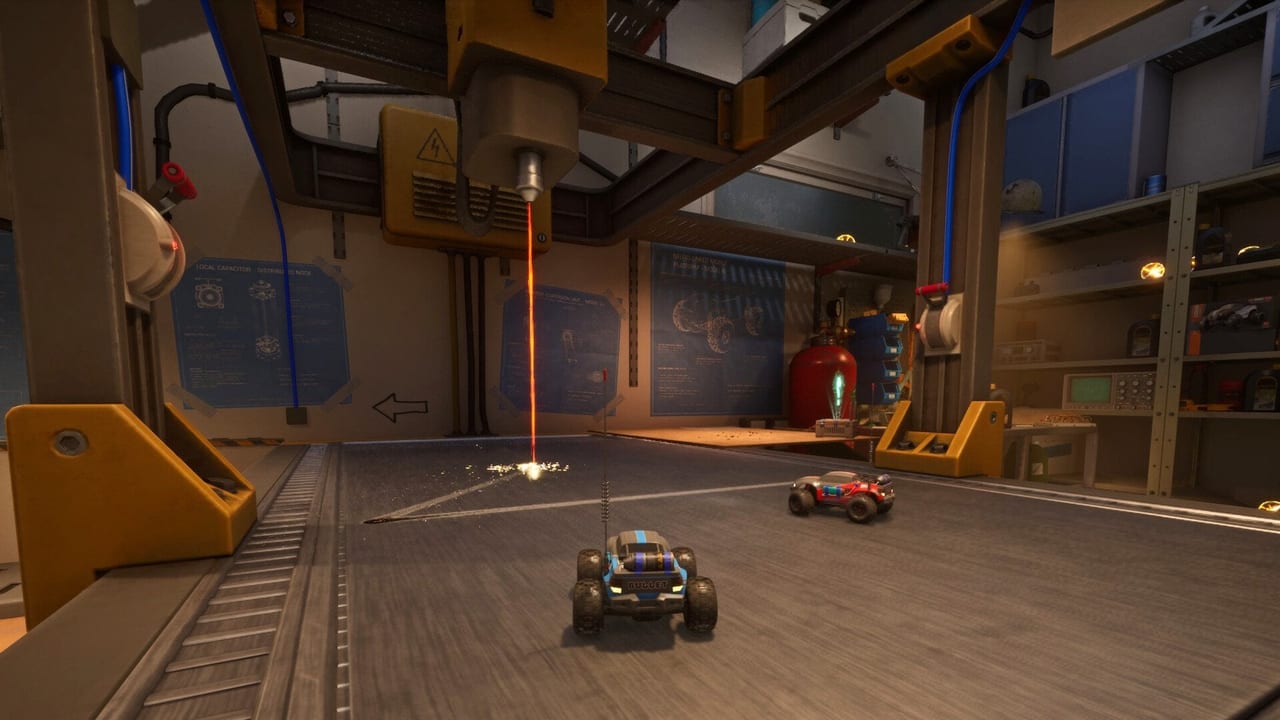
The Kitchen is where WheelMates teaches you to be small. Firevolt’s public demo started here, handed you the first power-ups, and only then opened the Garage. The full Steam campaign still uses the Kitchen as the first-hour classroom: driving on tabletops, squeezing under appliances, hitting radios, and learning that the second car is not optional. If you skipped Getting Started or How to Play, go back. This page assumes two drivers, a voice channel, and no desire to turn a fridge into a speedrun.
There is no combat in the Kitchen. There is no timer. There is a lot of furniture. Treat every object as either a ramp, a wall, a switch, or a story prop. If it is none of those, it is probably a secret for later gadgets, which is a secrets problem, not a reason to rage-quit the sink.
What the Kitchen is for
Professor Everett Bloom’s kitchen is a compact playground. You will race across shelves, drift around cluttered counters, and drop onto the floor when a vase or board becomes a bridge. Demo coverage and play sessions call out the same jobs: learn throttle and jump on the table, find a way to open doors under the sink, reach highlighted zones, and get to marked radios (players mentioned a red radio and a purple radio as early audio props). The top-right HUD names the current verb. Read it.
First power-ups live here. The exact unlock order can shift with a patch, but the Kitchen’s job is to put a new toy in your hands while the geometry is still readable. Magnetic wheels, a jump booster, or an early hook/winch all change a counter you already drove. That is the habit the rest of the house needs. If you blast through the Kitchen without using the new tool on an old shelf, the Garage’s open floor will feel like noise.
Audio is part of the room. Nodes and radios carry Bloom’s voice. One Kitchen-adjacent line from demo play talks about security, full sync, and a basement unlock if both cars do their part. Another thread of notes (memory cards and scans) jokes about toxic storage in a fridge and pipes under the island. You do not need every card to leave the room. You should still bump a radio when you are lost; the Kitchen is designed to talk.
First-hour route (no fake cupboard list)
- Confirm both cars can move. Split-screen player two should already have binds. Online guests should already be on Friend’s Pass. If someone cannot steer, stop. The Kitchen’s first puzzles already want two bodies.
- Drive the table as a tutorial track. Learn jump lips, 90-degree turns, and the follow camera. Lower sensitivity if the frame whips. Free camera is for spotting the floor route, not for the first straightaway.
- Follow highlighted zones and radios. When the HUD says reach two pads, it means both of you. When it names a radio, drive to the prop, not in circles around the microwave.
- Use the first power-up on something you already saw. A magnet surface, a gap, or a cover that did not make sense five minutes ago is the real checkpoint.
- Hold-hazard practice. If a door, flame, laser, or moving hazard needs one car parked, say “I hold, you go” and swap on the way back. This sentence returns in every later wing.
- Grab obvious collectibles only. Demo SD-style memory cards and scannable notes sit off the line. If a ledge is clearly gadget-gated, mark it and leave. The walkthrough is the grammar book; this room is the first paragraph.
Do not expect a named walkthrough of every drawer. Launch-week writers who list a spoiler for “the third spoon” are filling space. The Kitchen is small enough that looking is the guide. The Garage is where hidden paths start to need a method.
Demo versus full game
The Steam demo (Kitchen + Garage) ran from spring through 3 August 2026 and left Mostly Positive written feedback, roughly three quarters of about 404 demo reviews. Players liked the co-op toys and complained about camera sensitivity, keyboard split-screen, and some online desync. Firevolt used that build to add split-screen, 14 languages, Journal tracking, and handling tweaks. The full game still starts in this room, then keeps going past the Garage into Backyard and laboratory spaces the demo never sold as complete.
If you played the demo, do not skip the Kitchen on muscle memory. Settings, resets, and gadget timing may differ. If you never played the demo, you are not behind. The Kitchen is still the onboarding Firevolt chose. Steam Deck players should treat this room as a performance test: if the linoleum stutters, fix it before the Garage’s wider camera pulls.
Customization starts at the door. You pick a base color. Wheels, antenna, and horn pieces hide later in the house; a few may sit in Kitchen corners for players who look under the furniture. None of them beat learning magnet toggle discipline. A pretty horn will not hold a switch.
When you are stuck in the Kitchen
- Look at the top-right objective again. Then look at wires, arrows, and the second pad you have not visited.
- Toggle the gadget you just unlocked. Covers, metal splashbacks, and undersink doors are rarely solved by more speed.
- Reset instead of restarting the whole room if you fell behind the toaster.
- Swap who holds and who crosses. Asymmetrical roles are easier when the better jumper is the one who crosses.
- Keep voice up. There is no in-game voice chat. The Kitchen already punishes silent pairs.
When the room goes quiet and the HUD points you out, you are done. The Garage is the next named space: more air, more secrets, magnet grab, and rope swing. Come back to the Kitchen the moment a new gadget makes a fridge wall look sticky. That revisit is the campaign in miniature. Bloom left a mess on the counters on purpose. Your job is not to clean it. Your job is to drive it, together, until the house lets you into the next oversized room.
Frequently Asked Questions
Quick answers for two-player RC sessions.
Is the Kitchen in the demo and the full game?
Yes. The public demo used the Kitchen as the tutorial space before opening the Garage. The full campaign still starts here with the first power-ups.
What should we unlock first?
Whatever the room hands you. Use that gadget on a surface you already failed to climb. Magnetic wheels, jump, and early hook tools are all Kitchen-scale lessons for later rooms.
Where are the objectives?
Top-right of the HUD. Radios and nodes add audio hints. The Journal stores scans and memory cards so you can keep driving.
Can one player finish the Kitchen while the other watches?
No. Several beats need both cars on pads, one car holding a hazard, or a gadget the second player has to fire. This is a two-player room.
Should we hunt every collectible before leaving?
Grab what you can see. Leave gadget-gated ledges for a revisit. The eight-hour completion lives on the secrets page, not in a forced Kitchen 100 percent.