WheelMates Journal
Optional story fragments — the house talks if you slow down, and the next door opens if you do not.
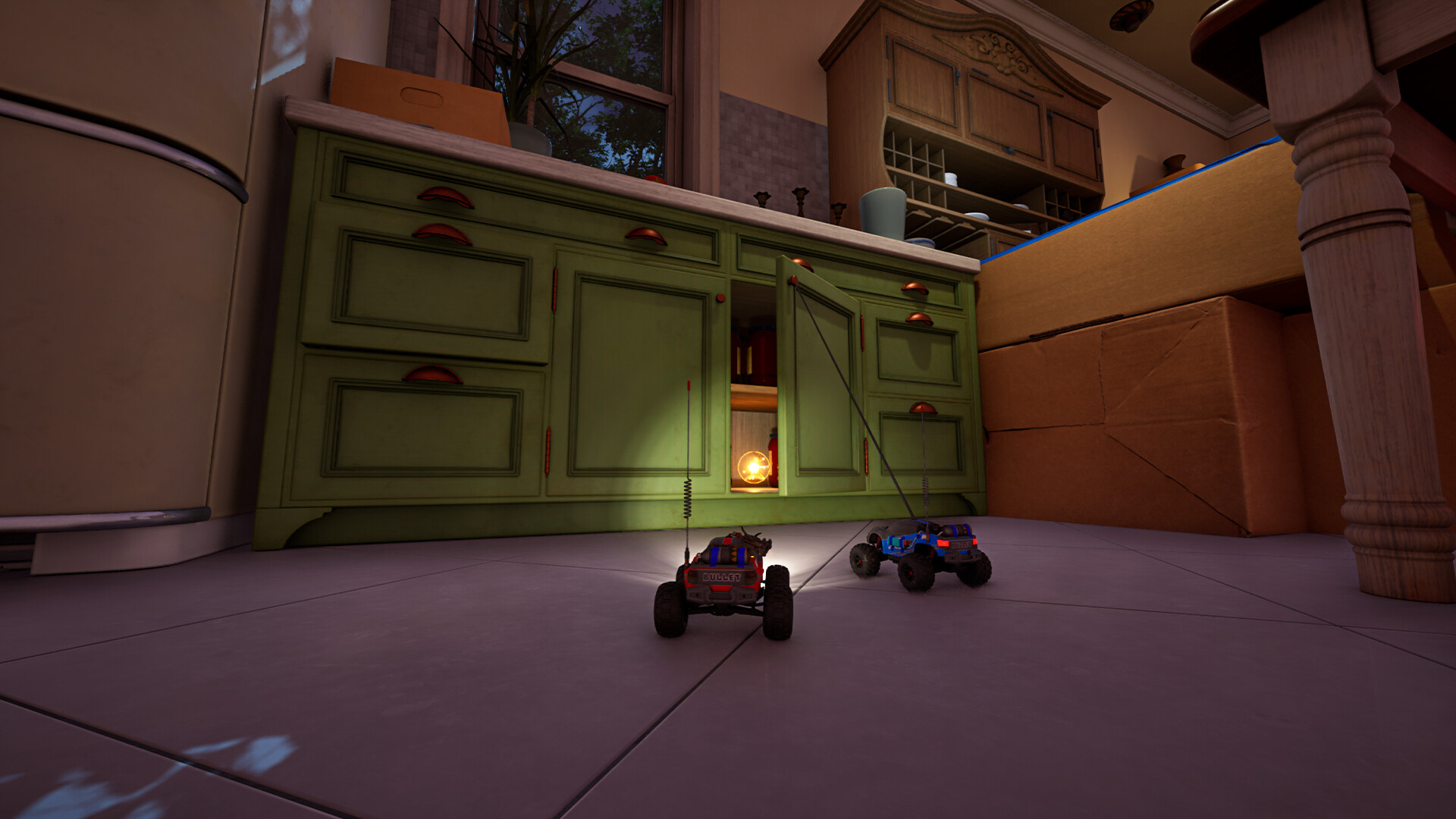
The Journal is WheelMates’ optional story layer, not a second campaign. Firevolt’s Devlog #2 (17 July 2026) is the design document: you can drive straight to the next location; nothing forces you to stop and examine every object. If you slow down, Professor Everett Bloom’s house tells a bigger story. The Journal is where those fragments sit so you can keep rolling and still reconstruct the mess later. It is not a critical-path item. The next door will open without it.
This page explains how that layer works: the three narrative types Firevolt named, the questions the house is actually asking, and how to hunt notes without turning a two-player RC night into homework. For room grammar, use the walkthrough. For the first furniture, use the Kitchen. For the outdoor wing, use the Backyard. For hidden rooms and cosmetics, use secrets. The Journal is the drawer those pages keep pointing at.
Critical path versus slowing down
The campaign is still mandatory two-player co-op on the 1 September 2026 Steam build for PC and Steam Deck. Online and split-screen both work. Friend’s Pass still covers the guest. There is no solo mode, no combat, and no timer. HUD objectives in the top-right tell you the verb that opens the next space. Radios and hint devices repeat useful directions when you are lost. None of that is the Journal. The Journal is the menu you open after (or during) a lap when you want to know why the house is empty.
Firevolt’s length estimate already encodes the split: about six hours if you follow the story markers, about eight if you chase secrets, mini-games, extra rooms, and the fragments the Journal is built to hold. A pair that hates lore can clear Kitchen, Garage, Backyard, and laboratory spaces on the six-hour line. A pair that likes lab gossip will scan, listen, and backtrack. Agree on the rule before the first radio. Guests can still help; keep the same host if you care about one save seeing the whole book.
The Next Fest demo update is when Journal tracking arrived in public builds. If you played an earlier Kitchen-only playtest, this drawer is new. If you skipped every scan in the demo, you are not behind on the campaign. You are behind on Bloom.
The three questions the house is asking
Devlog #2 does not hide the mystery. You may already know Bloom as the missing scientist who built the cars and sent the call for help. That is only the beginning:
- Who else lived in this house?
- Why is it empty now?
- What are the strange green chemicals found throughout it?
The answers are scattered as small fragments, not as a cutscene dump. The Journal gathers them so past and present can sit in one place. Green chemicals are a house-wide prop, not a Backyard-only gag and not a Kitchen-only fridge joke. If you only drive the painted line, you will still finish. You will not know who hissed at Bloom’s instruments.
Three narrative types (named by Firevolt)
1. Nodes with professor voice. These are a direct line to Everett. He guides, explains recent events, and sometimes talks about older days. Demo Kitchen audio already used this channel for security, full sync, and a basement unlock if both cars do their part. Treat a node as a radio with a face. You do not need every node. You should still bump one when the HUD has gone quiet and the room has not.
2. Scannable objects with personal notes. These show sides of Bloom he would not volunteer on a node. Demo play found fridge text, missing-cat notices, name tags, institute labels. If the game lets you scan it, scan it. Scans are how the house admits other people lived here. They are also easy to drive past because nothing explodes when you skip them.
3. Memory cards with audio logs. Longer arguments. Lab gossip. The kind of recording that survives after the speakers have left. Firevolt published a real line from this layer: “Everett, seriously? A kitchen fridge for toxic BH-19? You ran pipes right under the island.” That sentence does three jobs: it names the chemical, it places it in the Kitchen, and it proves someone else was in the house long enough to be angry. Other cards in the same devlog include notes Bloom wrote himself, including a postscript to Snowball the cat. We will not invent extra quotes. We will tell you to pick the card up when you see it.
Memory cards in the demo were SD-style collectibles. They sit off the critical path on purpose. A ledge that is clearly gadget-gated is a secrets revisit, not a Journal fail. The eight-hour completion is this drawer plus hidden rooms, not a forced transcript of every log before you are allowed to leave a counter.
How to use the Journal without stopping the session
- Play the room once for the HUD, once for scans. That is the same two-pass method as a secret hunt, with a different prize.
- When a node talks, let it finish. Then look at the furniture it named. Pipes under the island are a Kitchen fact you can verify with your eyes.
- Open the Journal between rooms, not in the middle of a two-station crane. The feature exists so you can keep driving.
- Call finds. There is no in-game voice chat. “Card under the cabinet” is a co-op sentence. A silent sweep is how pairs miss the second object on a shelf.
- Do not grind a scan that needs a later gadget. Mark it. The Metroidvania loop is how both secrets and story hide.
Green chemicals are a visual through-line. Demo cars already learned that BH-19 byproduct is highly conductive and that driving into the wrong puddle is a boom, not a story beat. Hazard goop and lore goop can share a color. Read the HUD if you are about to explode. Read the Journal if you want to know why Bloom ran pipes under a kitchen island.
The Backyard is a good reminder that fragments are not only indoor. Antennas, dusk, and a lot that is wired into the house are story geometry even if you never open the menu. The living room and “under the sofa” line from Next Fest copy is the same idea: the house is a laboratory wearing domestic furniture. Laboratory spaces later will keep the chemicals and the questions. We will not pretend we have a sourced list of every card in those wings. Launch-week maps are still being drawn. Looking is the guide.
What the Journal is not
It is not a solo mode. It is not a timer. It is not required to beat the game. It is not a spoiler novel this wiki will finish for you. If a guide dumps a fake transcript of every audio log after the Garage, it is guessing. Use the walkthrough when you need the next door. Use this page when you want the drawer.
Firevolt built a critical path you can charge through and a place for people who slow down. Either choice is the design. When a memory card yells at Everett for storing toxic BH-19 in a fridge, you are not off-route. You are finally reading the house that has been under the cars the whole time.
Frequently Asked Questions
Quick answers for two-player RC sessions.
Do we need the Journal to finish WheelMates?
No. Firevolt said you can drive to the next location without examining every object. HUD objectives open doors. The Journal stores optional fragments so you can keep driving.
What are the three narrative types?
Devlog #2 names them: nodes with professor voice, scannable objects with personal notes, and memory cards with audio logs. Each room can hold more than one type.
What is BH-19?
A toxic chemical from a real memory-card line: someone yells at Everett for storing it in a Kitchen fridge and running pipes under the island. Green chemicals show up throughout the house. We will not invent a full formula.
Where should we look for Journal fragments?
Can we skip memory cards and still beat the story?
Yes. Cards are optional audio logs. Skipping them does not lock the next location. It only thins the answers to who else lived here and why the house is empty.
Does a Friend's Pass guest share the Journal?
The guest plays the full campaign with the host. Keep the same host if you care about one save seeing every scan. Secrets and story still need two cars.